


Neural rendering represents one of the most significant evolutions in the field of computer graphics. This technology combines artificial neural networks and traditional rendering techniques to generate photorealistic images more efficiently. In interior design, neural rendering is opening new possibilities for digitizing showrooms, creating virtual tours, and accelerating workflows without compromising visual quality. Let’s take a closer look at what it is all about!
What is neural rendering
Neural rendering is a set of techniques that use artificial neural networks to generate, complete, or enhance rendered images. Unlike traditional rendering, which physically simulates the behavior of light through complex mathematical algorithms, neural rendering leverages machine learning to optimize or accelerate specific stages of the process. Neural networks are trained on large amounts of visual data and learn to recognize patterns, textures, lighting, and depth. Once trained, they can generate realistic images from partial inputs or improve the quality of existing renderings.
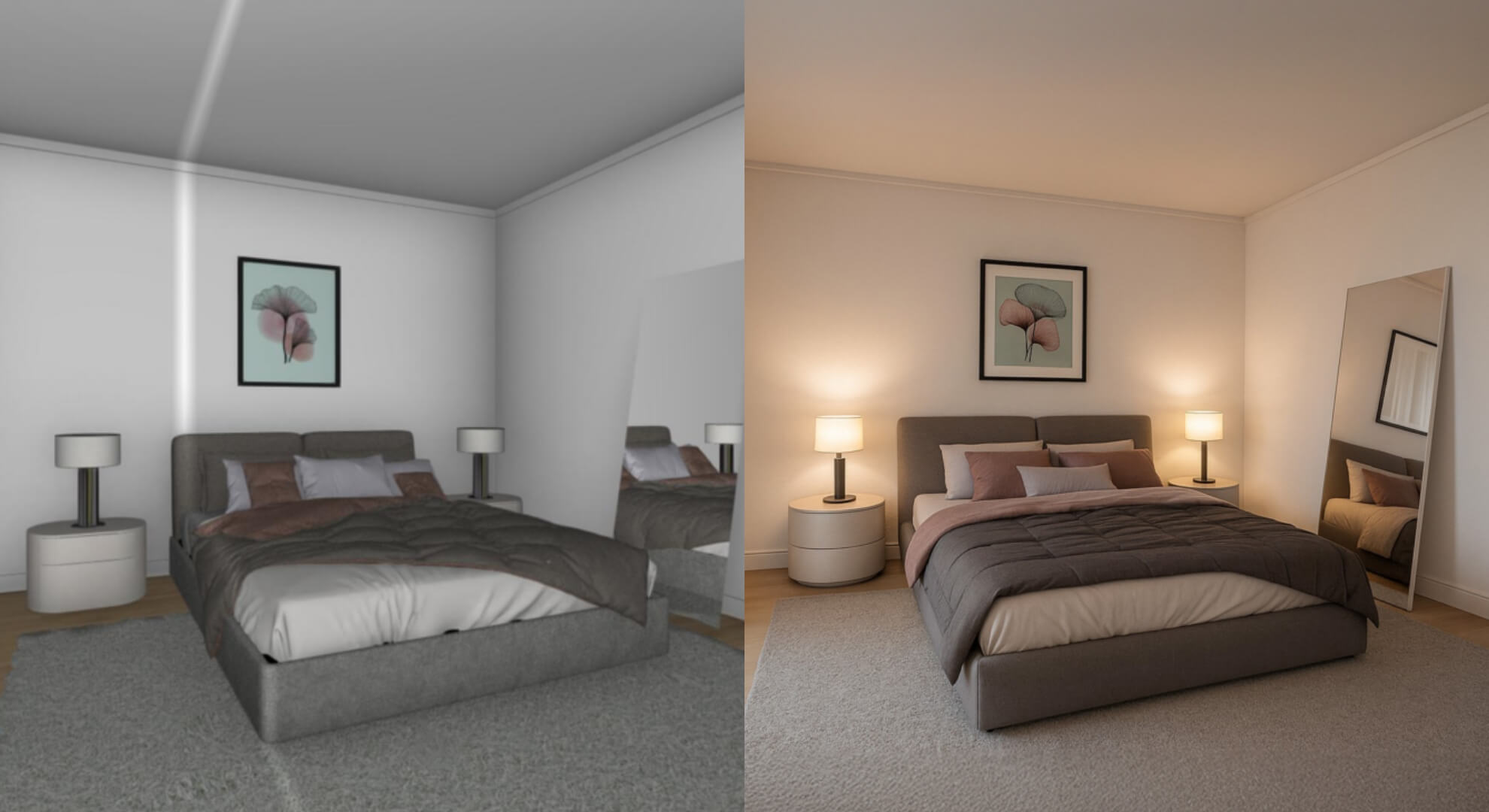
Differences from traditional rendering
Traditional rendering is based on physical simulations of light: ray tracing, path tracing, and radiosity calculate how light rays interact with surfaces. This approach guarantees technical accuracy but requires high computational power. Neural rendering does not completely replace these methods. In most cases, it integrates with traditional techniques to reduce computation times or improve photorealism. The most advanced approaches combine physics and artificial intelligence in hybrid solutions: physical simulation provides the foundation, while AI optimizes details, removes noise, or generates additional views.
How neural rendering works
Neural rendering is based on convolutional neural networks (CNNs) or more advanced architectures such as transformers, trained on specific datasets. The process is structured in three main phases:
- 1. Model training
The neural network is exposed to thousands or millions of reference images. During training, it learns relationships between geometry, materials, lighting, and the final visual result. This process requires significant computational resources and accurate datasets. - 2. Inference
Once trained, the model can be applied to new scenarios. Starting from partial inputs (for example, simplified 3D geometry or a few images of a scene), the neural network generates photorealistic outputs in significantly less time than traditional rendering. - 3. Post-processing and optimization
In many workflows, neural rendering is used to enhance already rendered images: noise removal, resolution upscaling, and generation of intermediate frames for smooth animations.
Neural Radiance Fields (NeRF)
One of the most innovative applications of neural rendering is represented by Neural Radiance Fields (NeRF). This technique makes it possible to reconstruct photorealistic three-dimensional scenes from a series of 2D photographs. The NeRF model learns a continuous representation of light in three-dimensional space. Once trained on images of a real scene, it can generate new views from angles that were never photographed, maintaining geometric consistency and photorealism.
Applications of neural rendering in interior design
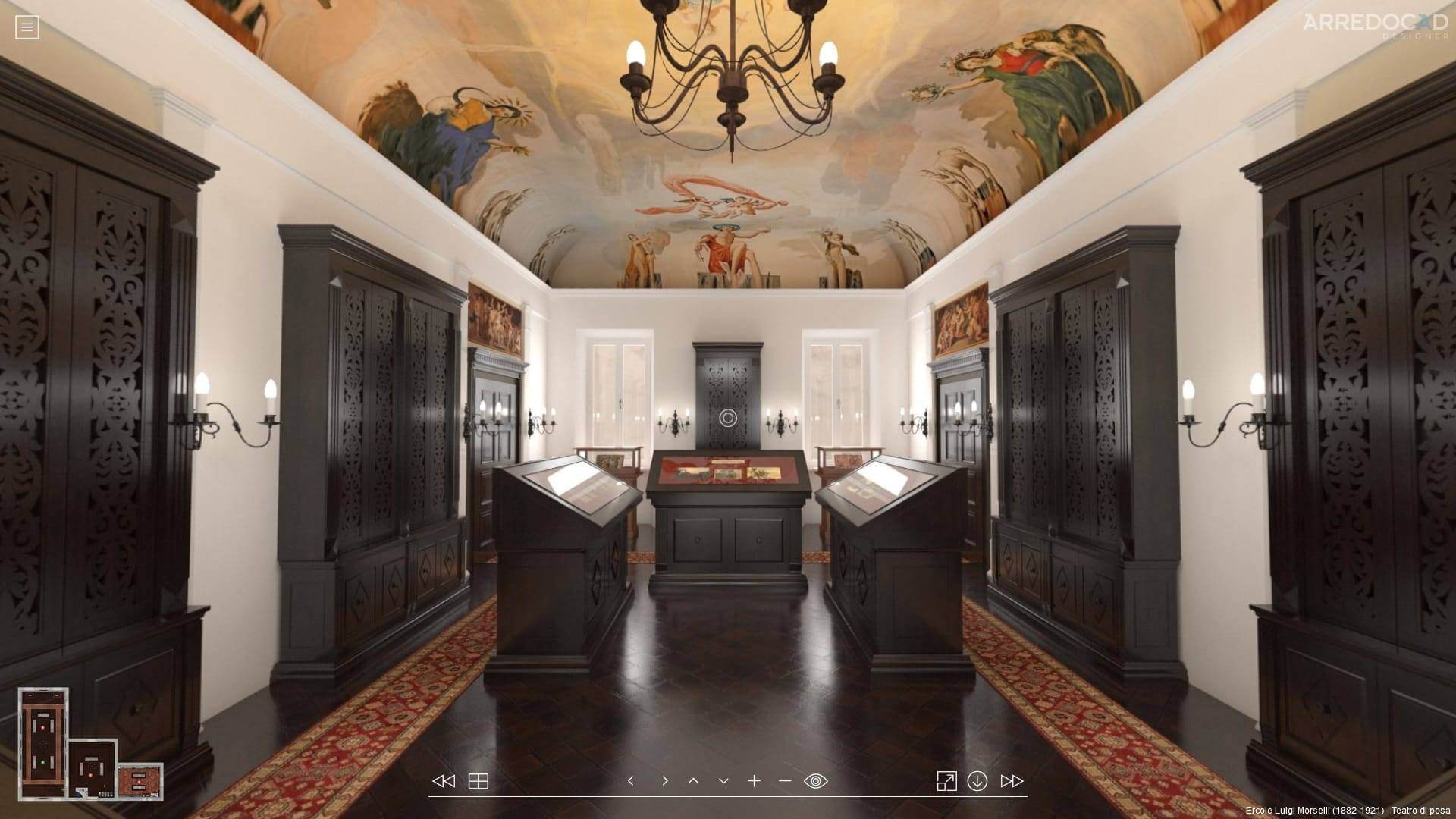
Digitization of showrooms and real spaces Technologies such as NeRF make it possible to digitize physical showrooms starting from simple photographic or video captures. This feature is particularly useful for furniture retailers and manufacturers who want to create immersive customer experiences without investing in expensive 3D laser scans.
Photorealistic virtual tours
Neural rendering can accelerate the creation of 360° virtual tours by improving the visual quality of complex environments. By integrating data from traditional rendering with AI-based post-processing, smooth and realistic navigation experiences can be achieved.
Rapid preview generation
During the early stages of design, neural rendering can generate photorealistic previews from simplified geometry, reducing waiting times and enabling faster iterations with clients. This approach does not replace final high-quality rendering, but it speeds up the decision-making process.
Improved photorealism
AI-based denoising and super-resolution techniques make it possible to obtain cleaner and more detailed images from lower-resolution renderings. This reduces computation times without compromising perceived final quality.
Advantages and limitations of neural rendering
Advantages
- Reduced computation time:
in specific scenarios, neural rendering can generate complex images in a fraction of the time required by traditional path tracing. - High photorealism:
eural networks can learn complex visual patterns and replicate them with great fidelity. - Content generation from incomplete data:
NeRF and similar techniques enable the reconstruction of complete 3D scenes from partial inputs. - Integration with existing workflows:
neural rendering can complement traditional engines as a post-rendering optimization.
Limitations
Like any emerging technology, neural rendering presents some challenges that limit its immediate adoption in all professional contexts.
- Dependence on training datasets:
the quality of the output depends on the quantity and quality of the data used to train the neural network. In the absence of specific datasets, results may be… - Hardware requirements:
training neural networks requires modern GPUs with dedicated AI units. GPUs equipped with Tensor Cores significantly accelerate these processes, but they still represent a hardware investment.
For these reasons, the most advanced approaches combine traditional rendering and AI in hybrid solutions, leveraging the strengths of both technologies.
Why physical rendering remains essential for design
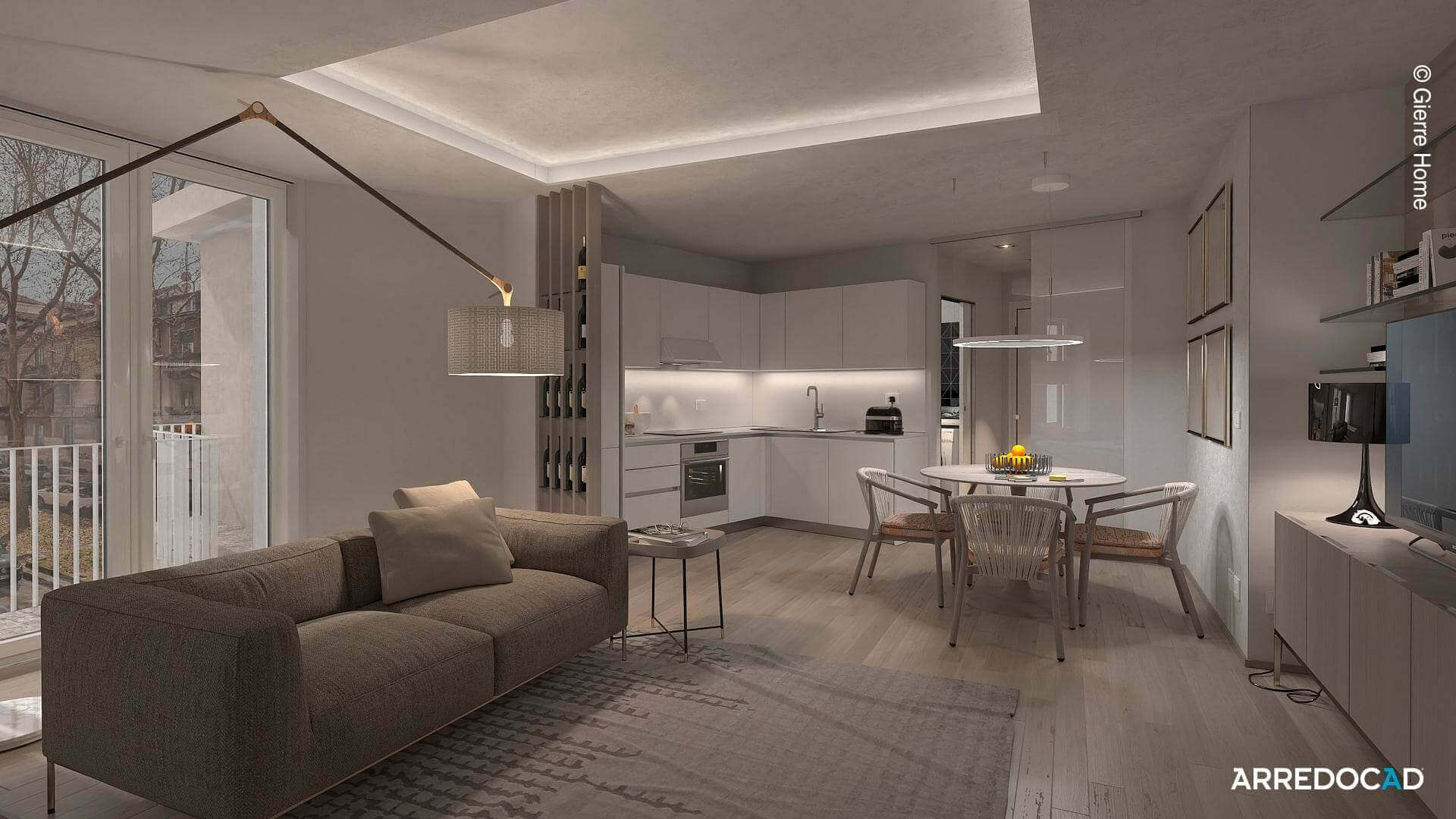
n the furniture and interior design sector, rendering based on physical simulation represents the professional standard for specific reasons. Designing a kitchen, living room, or bathroom requires millimeter-level precision: every reflection on lacquered surfaces, every caustic effect on transparent materials, every interaction between natural and artificial light must be calculated accurately.
Physical rendering guarantees:
- absolute predictability: every parameter is controllable and verifiable
- technical compliance: measurements, proportions, and distances are mathematically exact
- professional reliability: the final result always matches the design specifications
Neural rendering and hardware: the role of modern GPUs
Modern GPUs have made the practical adoption of neural rendering in professional environments possible. Unlike CPUs, designed for sequential processing, GPUs handle thousands of parallel operations, ideal for neural network computation.
The latest GPU architectures integrate dedicated computing units specifically designed to accelerate machine learning operations. This hardware specialization enables real-time neural network inference, making neural rendering usable in interactive workflows.
Technologies such as DLSS (Deep Learning Super Sampling) demonstrate how the integration of traditional rendering and AI can improve both performance and visual quality. DLSS uses neural networks to reconstruct high-resolution images from lower-resolution rendered frames, drastically reducing computational load without perceptible loss of detail.
Neural rendering and design
Professional software such as ArredoCAD Designer relies on physical rendering engines because they guarantee technical precision, design control, and reliability in production workflows. This is not a limitation, but a strategic choice: in professional furniture design, where every project must translate into a real physical implementation, millimeter-accurate correspondence between digital visualization and the final product is essential!
The key question is not “which technology is more advanced,” but “which technology best serves professionals.” For interior designers, architects, and furniture retailers, controllable physical rendering remains the reference standard.
The future lies in intelligent integration: AI does not replace physical simulation — it complements it where it can improve efficiency without compromising accuracy.


